

Report from Serbia - Student protests and theater strike against corruption in politics
Students are champions
March 6, 2025. Even tennis star Novak Djokovic is already showing solidarity: in Serbia, a student movement that originated at the Faculty of Dramatic Arts in Belgrade is growing into a nationwide protest movement. They are demanding accountability for a construction accident in Novi Sad and an end to corruption in the country. Tomorrow, Friday, there will be a strike in large parts of the cultural sector.
By Natasha Tripney
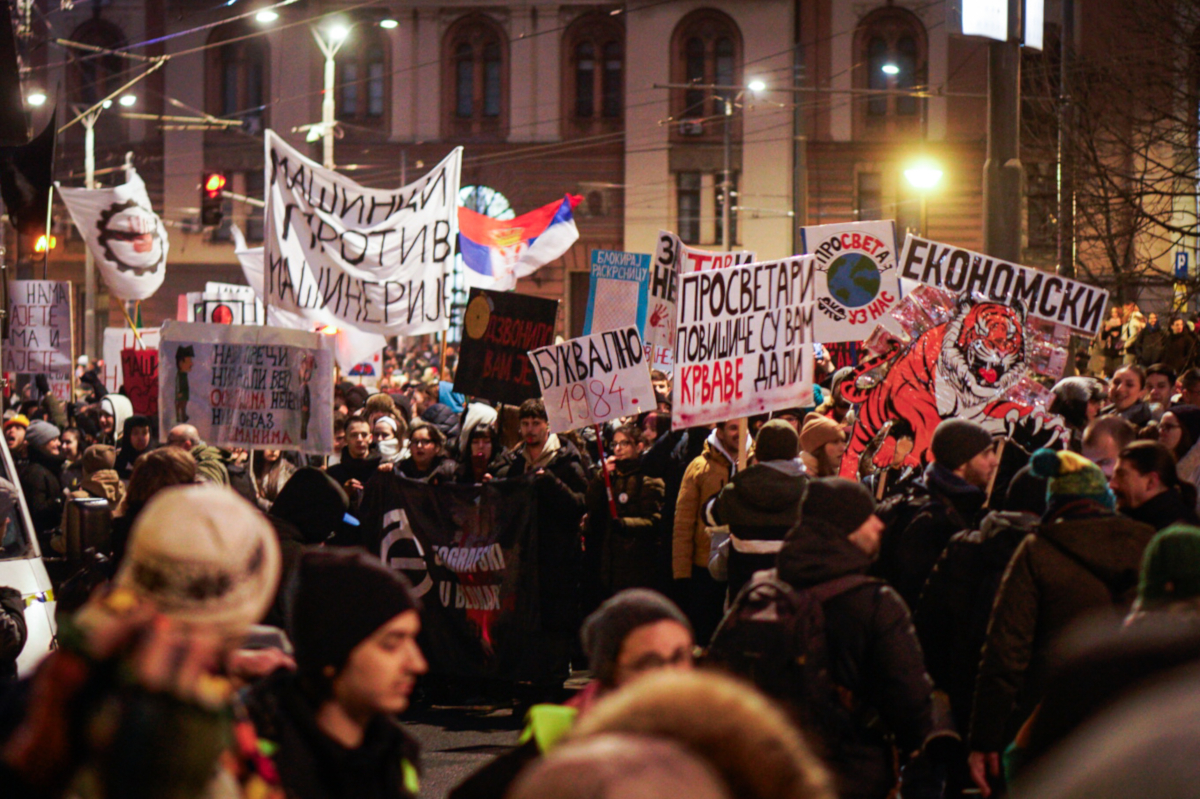
Protests in Kragujevac © Faculty of Dramatic Art, Belgrade
March 6, 2025. Tuesday 4th March marked the 100th day that the Faculty of Dramatic Arts in Belgrade has been occupied by its students. Classes have been cancelled, and the students have set up dormitories and a kitchen in the building. They are not alone. A large number of faculties across Serbia have been occupied in a similar way, as part of a wider wave of anti-corruption protests which have been sweeping the country.
The protests were sparked by the collapse of a concrete canopy at the main railway station in Novi Sad, Serbia’s second city, on 1st November 2024, which killed fifteen people. The station had only recently been renovated, and many people attributed this tragedy to a deep-rooted culture of corruption and nepotism. People took to holding 15-minute silent vigils in memory of the dead, starting at 11.52 each day, the moment when the canopy collapsed.
A growing protest
On 22nd November, a group of theatre students from the Faculty of Dramatic Arts in Belgrade were holding one of these vigils when they were attacked by passing motorists. Some of those responsible turned out to have state connections. The students responded by occupying their faculty building and issuing a set of demands. They wanted documents related to the recent renovation of the Novi Sad railway station to be made public and for those responsible both for the collapse of the canopy and the attacks on them to face prosecution. “This is a fight for justice," explains Vanja Šević, a student at the Faculty of Dramatic Arts in Belgrade. "We want the institutions to do their jobs."
What began at the Faculty of Dramatic Art rapidly expanded. Other faculties have followed its lead. The protests also grew in scale from 15-minute silent vigils to mass gatherings. On 22nd December over 100,000 people gathered in downtown Belgrade, in what was one of the biggest protests the country has seen since the 1990s. The protesters were no longer just students. The farmers' unions were also actively involved, but many people present were citizens keen to express their frustration with President Aleksandar Vučić's government.
The ruling Serbian Progressive party (SNS) has been in power since 2012, and Vučić, has been president for the last eight years. During that time, as reported by Freedom House, there has been a steady erosion of political rights and civil liberties. Career progression is very much dependent on party connections and many young people struggle to envision a future under the current regime.
The students have been remarkably organised from the outset. Their movement is leaderless. Every decision is made by the students via plenum. They have maintained a clear distance from Serbia’s fragmented opposition, who this week set off flares and smoke bombs during the opening session of parliament in a misguided show of support for the students.
Earning sympathy with warmth and humor
The students, by contrast, have been altogether more restrained. They scrupulously clean up after every action and protest, knowing that their actions will be scrutinised. They understand how to use social media as a tool to connect with people. Theatre students have been leading the way during the protests, and they understand the importance of narrative. They have brought warmth, humour and a sense of fun to many of their protests. When they staged a 24-hour blockade of a key motorway intersection in Belgrade, they camped out, played music and ballgames and roasted meat, creating an upbeat atmosphere. But their goal is a serious one, a call for accountability and systemic change.
On occasion the students have been met with aggression. On several occasions cars have been driven at them and one young woman was violently attacked in Novi Sad, but these incidents have been widely condemned and, if anything, increased public support for the students. Even the Serbian tennis player Novak Djokovic has been photographed wearing a sweatshirt saying "Students are Champions".
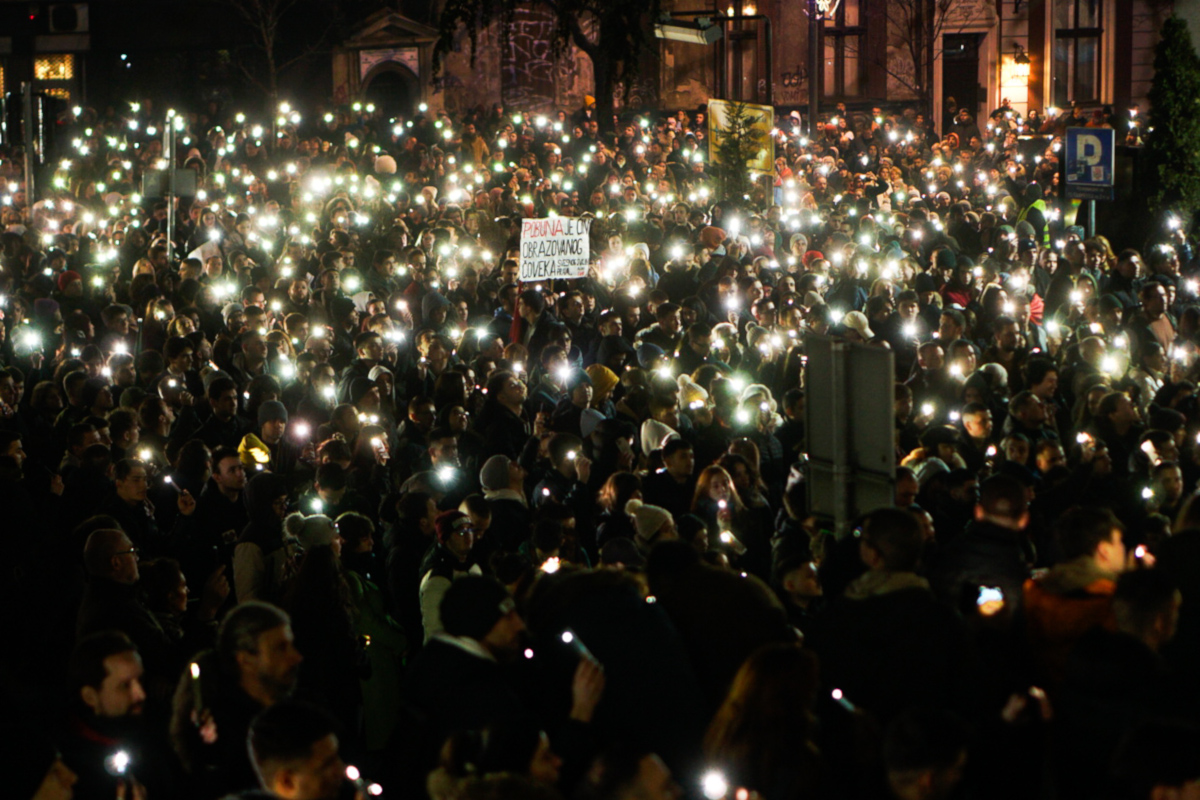 Protests in Kragujevac © Faculty of Dramatic Art, Belgrade
From the start of the protests, the theatre community has been very vocal in its support of the students. Initially this took the form of reading statements of support at the curtain call, but performers also took to wearing red gloves to signal their support – the bloody red handprint has become a symbol of the protests. From 10th–17th February Serbian actors went on a seven-day strike, the first strike of its kind in Serbia's history. Theatres across Belgrade, as well as theatres around the country, went dark.
On 11th February, the second day of the actors’ strike, the students embarked on a "travelling theatre" tour through the streets of Belgrade. At each theatre they passed they were greeted and cheered on by the ensembles. In front of "Atelje 21"2, one of the city's most prestigious theatres with a history of presenting avant-garde work, the ensemble sang ‘Let the Sunshine In’ from the musical Hair, a show with a historic connection with the theatre. The Belgrade production of the countercultural musical opened at "Atelje 212" in 1969, a year after its Broadway premiere.
"This day was one of the most important and emotionally charged of my professional career so far," says actor Ivan Mihailović, part of the "Atelje 212" ensemble. Actors have been noticeably vocal in their support of the students. he says, because “we have a particular power in the public sphere which allows us to reach a large number of people more easily." Some actors have also been performing for the students, staging productions inside the faculty buildings, as part of a wider programme of cultural activities that the students have been organising. For the students at the Faculty of Dramatic Arts, the actors' strike was particularly significant because, says Šević, "we are colleagues. We hope to go down the same career path."
The strike was more than just a gesture of solidarity. The students have urged people to look within their own intuitions, to, as Mihailović puts it, "clean our own courtyards". The actors' guild prepared their own set of demands, calling for improvements to working conditions and pay in the theatre sector, as well as an increase to Serbia’s cultural budget. The demands, ultimately, were not met.
While actors were among the first to speak out in support of the students, says Mihailović, they are not alone. "Many have stopped staying silent and fearing to express what they have long thought. The students have given us all new strength." Other sectors have been striking. There was a general strike on 24th January in which many bookshops, bars and cultural organisations closed their doors. Another is planned for 7th March.
The long march from town to town
In recent weeks the students have taken from city to city in recent weeks. This started early in February when students from Belgrade made the decision to walk 80km to join their fellow students for a protest in Novi Sad. This two-day walk took them through various smaller towns where they were often warmly greeted. One of the biggest challenges the students have faced is that most Serbian media is state-controlled and there has been very little coverage of the protests on RTS, the main state channel. (One of the things students have been doing to combat this is to film their own parody news broadcasts). Their decision to walk to Novi Sad had the inadvertent consequence of bringing them directly into contact with people and allowing them to talk to them face-to-face. This has led to emotional scenes, with many older people visibly moved by the young people’s arrival in their towns.
A couple of weeks later the students embarked on a walk to Kragujevac in central Serbia, their arrival scheduled for 15th February, Serbian Statehood Day. The date was significant as it commemorates the first Serbian constitution, which was adopted in 1835 in Kragujevac, and throughout the protests, the students have framed themselves as the upholders of the constitution.
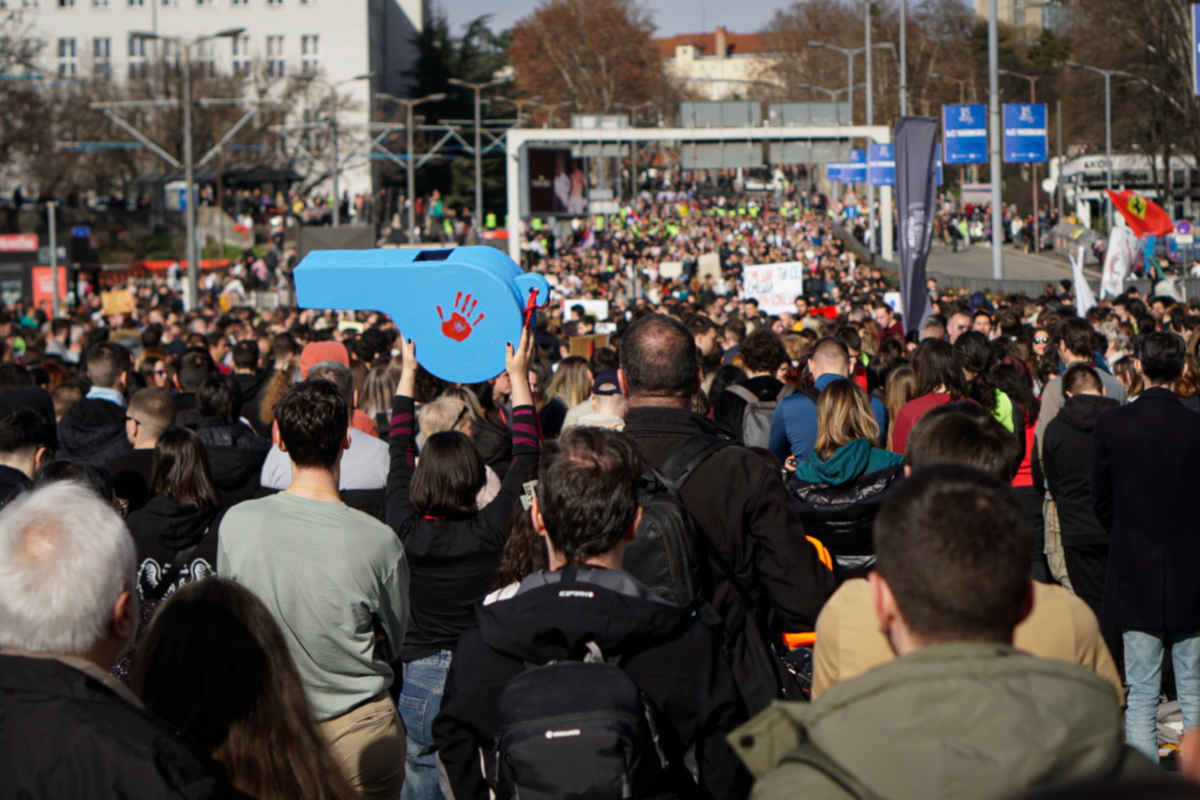 Protests in Kragujevac © Faculty of Dramatic Art, Belgrade
On 1st March, four months after the collapse of the canopy, the students arrived in Niš in southern Serbia and were met were met with a hero’s welcome. Many of them were weary and limping having walked for days to get there. While the mood was jubilant, the protestors never lost sight of the fact that 15 people lost their lives in the tragedy of Novi Sad, and two other critically injured people remain in hospital. Wherever they go they ensure there is always a pause for 15 minutes of silence.
Rarely a day goes by now with some form of action or protest taking place. The sound of distant whistles has become part of the music of day-to-day life. They are starting to have an impact. Since the protests began some of the documents relating to the renovation of the station have been released. There have also been several resignations, including the country’s Prime Minister Miloš Vučević, as well as several arrests, including the former mayor of Niš. At the same time, President Vučić continues to frame these protests as the work of “foreign interference” and has staged counter rallies, the most recent of which took place in the relatively small town of Sremska Mitrovica rather than in any of the big cities, in which he talks of colour revolution and forces out to destroy Serbia. The students, on their part, have shown no interest in engaging with Vučić directly. Instead, they reiterate that they are waiting for their demands to be met.
Knowledge and work instead of obedience
The question remains how long the students can sustain this. There will come a time soon when they may have to sacrifice an academic year, something that will be easier for some to do than others. Despite this, the students seem adamant that they will keep going until their demands are met. In Niš, they issued an edict stating "we want institutions that work in the interest of all of us, not to our detriment. We want a system that values knowledge and work, not obedience."
The students are providing a model of what resistance can look like and what can be achieved collectively. They are changing the public mood, cutting through climate of oppression and fear that has shrouded Serbia in recent years. As Mihailović said, the students are giving people strength – they are reinvigorating those who may have abandoned hope that change was possible.
This is the original English text by Natasha Tripney. You can find the German translation here.
meldungen >
- 17. April 2026 Kunststiftung Sachsen-Anhalt warnt vor nationalistischer Kulturpolitik
- 16. April 2026 Göttingen: Schauspielerin Thyra Uhde gestorben
- 16. April 2026 Salzburg: Ex-Festspielpräsident Heinrich Wiesmüller gestorben
- 16. April 2026 Konstanz: Intendantin Karin Becker verlängert
- 15. April 2026 Preisjurys der Mülheimer Theatertage 2026
- 13. April 2026 Chemnitz: Theater wehrt sich gegen Abschaffungspläne
theaterfestivals
 FINDE DEIN FESTIVAL!

nachtkritikregional

nachtkritikcharts
 TOP TEN DES THEATERS
dertheaterpodcast
nachtkritikvorschau

nachtkritiknewsletter
 JETZT ABONNIEREN
neueste kommentare >