

Letter from Georgia – Director Data Tavadze about the mass protests in Tblisi and beyond
Georgian Nightmare
February 11, 2025. At the end of last year, the "Georgian Dream" party came to power in Georgia through allegedly rigged elections. Since then, it has pursued an extremely pro-Russian and radically anti-European course. This has triggered nationwide mass unrest. Theaters are fighting on the front line. A report.
By Data Tavadze
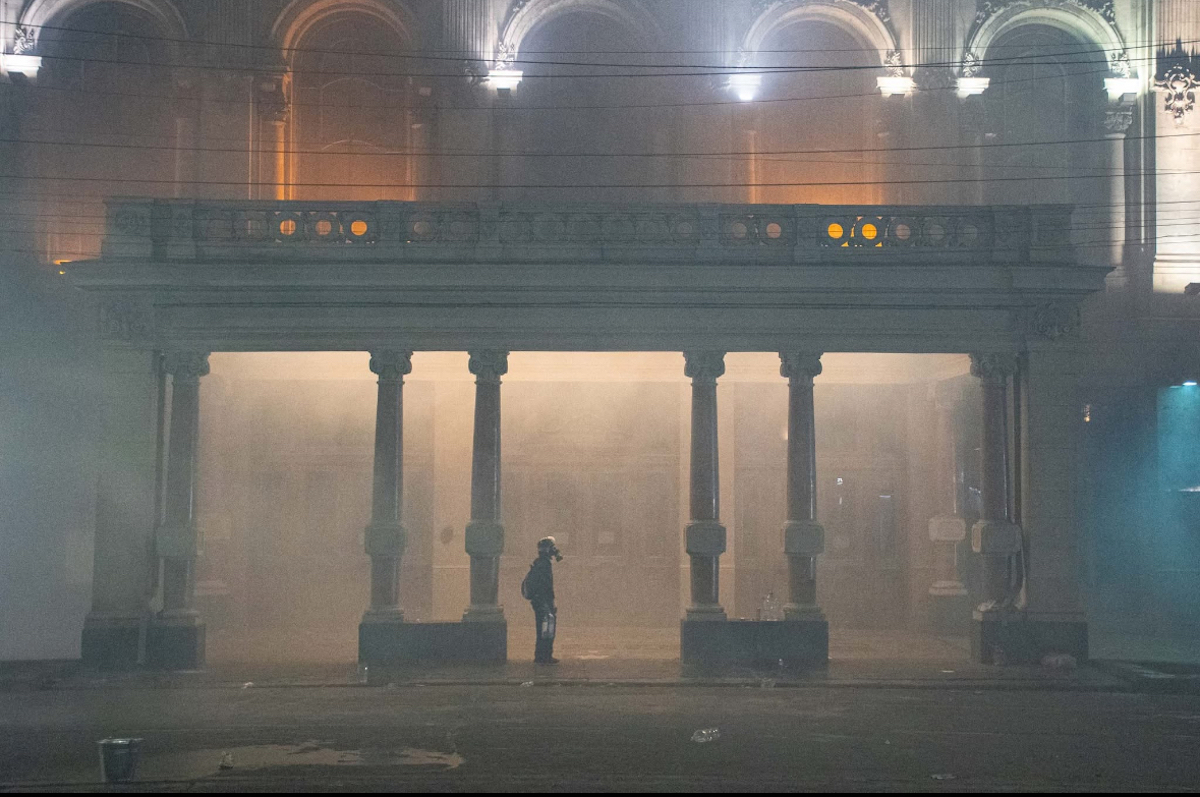
Tblisi: The Rustaveli National Theater in a fog of tear gas © Mariam Nikuradze
February 11, 2025. For more than three months, Georgia has been a stage of relentless resistance. Across cities, districts, streets, universities, and theatres, tens of thousands have mobilized against the Russian oligarch Ivanishvili and his government's authoritarian and fascist-leaning actions.
They refuse to accept the results of the rigged elections held on October 26. A month later, an announcement from the de facto Prime Minister of the "Georgian Dream" Party followed, which halted the country's European integration and negotiations with the EU regarding the accession process until 2028. The mass protests followed, continuing till this day, and Georgian theatre is at the forefront of it.
The Storm of People is Coming! — a chant that now echoes as a declaration of stubborn defiance. This movement, rooted in demands for democracy, freedom, and European integration, has transformed public squares into arenas of civic engagement and artistic expression. As repression escalates, so does the determination of those fighting for their country's future. Police have responded with brutality, mass arrests, and torture in detention centres.
New authoritarian laws have been implemented, banning masks at demonstrations, prohibiting blocking of the streets, and introducing the chilling concept of arresting individuals for 'potential crimes' that gives security forces unchecked power to detain activists before they can act. Despite these draconian measures, the movement persists. There had been no day that the main avenue in Tbilisi would not be blocked, even on New Year's night, when people put the kilometre table to share food and encourage each other in the hopes for the new year coming with the victory of people against dictatorship.
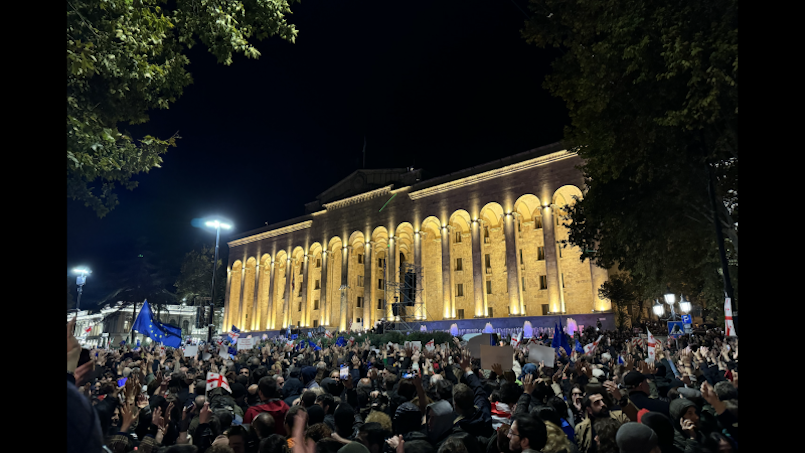 Tens of thousands demonstrate in front of the Georgian parliament on November 28, 2024 - Image: Videostill
As the regime intensifies its crackdowns, protesters prepare for the next phase of their struggle — "The Second Act" —, determined to prove that the spirit of resistance will not weaken. The theatre of resistance is set, and the world watches as the people take centre stage once again, demanding new elections and immediate release of those unlawfully arrested.
WE ARE ON OUR WAY, GEORGIA, HOLD ON!
For a month after the elections, we were in a state of shock and numbness following the disappointment of the rigged results. We gathered in smaller numbers in front of Tbilisi State University or State University in Batumi since mainly students led the demonstrations. We slept in tents blocking the streets while police occasionally beat our fellow protestors and arrested some of them.
One of the most shocking images from those days was when police forces emerged from the building of Tbilisi State University. I thought to myself, This marks the state of Georgian culture under this government! — The country's oldest and largest University, the symbol of resistance against Russian imperialism, with its students or professors known for being at the epicentre of every major historical change or with its tradition of researching Georgian history and protecting the language under Russian rule. Now, its garden was filled with armed forces supporting a pro-Russian government, going against the very students who study there.
One would hope that any university would serve as a sanctuary for students fighting for their rights, as the primary protector of their freedom of speech and thought. Yet, it has become a primary source of physical danger for them. Students no longer seek refuge there as once; instead, they run out, chased by the police.
A wounded future, desperate anger
Amid the frustration, Georgia's only glimmer of hope was its prospects for European integration. However, the so-called Prime Minister crushed that fragile hope when he announced the cancellation of the negotiations with the EU regarding the accession process.
On the evening of November 28, people began to gather for an unannounced demonstration, as if once more called by history itself, to the sacred place — Rustaveli Avenue, the arena for every significant change in the country, right in front of Parliament.
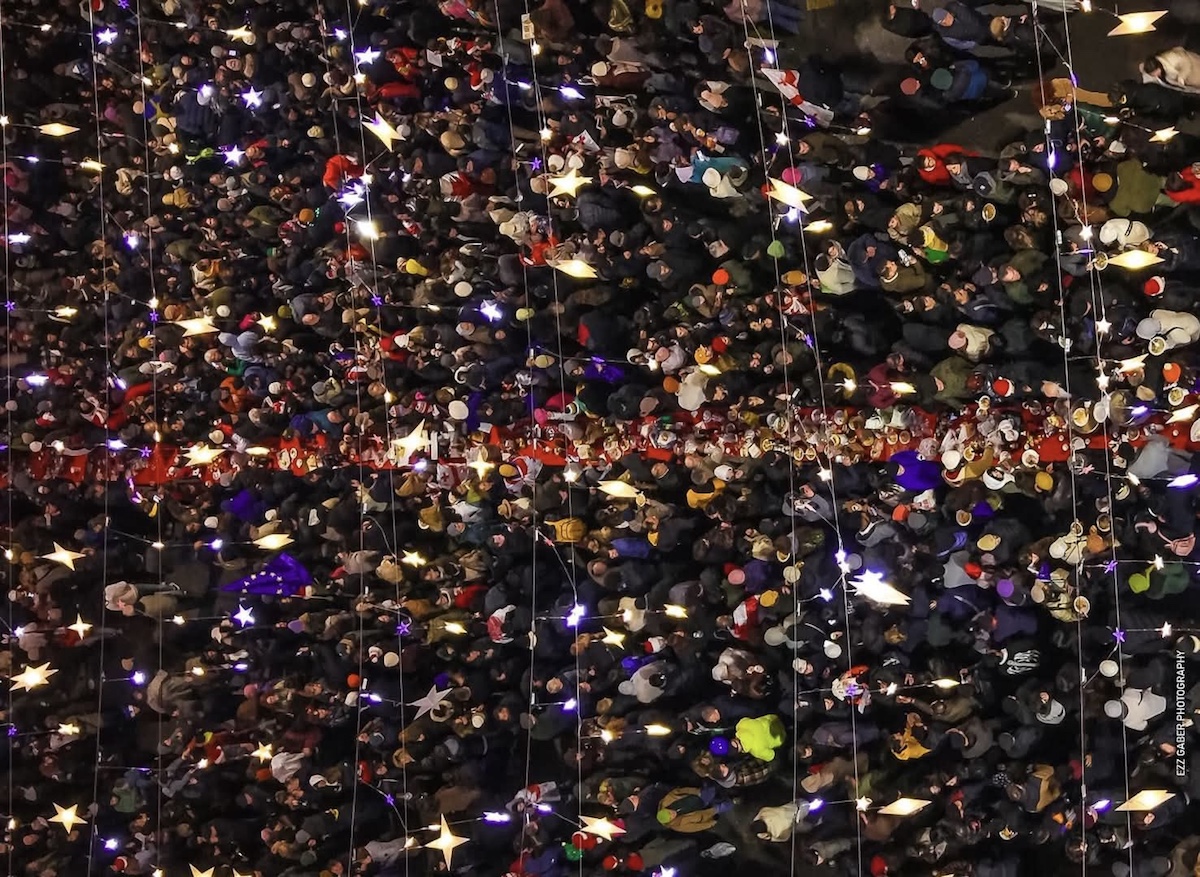 New Year's Eve 2024: The citizens of TBlissi celebrate and demonstrate for a free New Year at a red table several kilometers long on Rustaveli Blvd. © Ez Gaber
That evening, the future of the country felt wounded and bleeding. A crowd gathered in quiet anticipation, bracing for something terrible to happen. No one spoke; hundreds of thousands stood in profound silence, filled with rage. The only sound echoing down the avenue was the desperate banging on police barricades by demonstrators of all ages and professions. People from all social groups— unknown faces and famous ones, students and retirees — stood together, creating a haunting rhythm that resembled a mourning ritual lasting for hours.
For a month prior, we searched for words to express our discontent, and here they were — that banging was our language.
No more walls! No more Iron Curtains! The people arrived!... and so did the special police forces, starting the twenty days of severe and brutal crackdowns on demonstrations—that involved unlawful detentions, arrests, and violent assaults on civilians and journalists carrying out their duties. Survivors and human rights organizations reported hundreds of cases of torture and numerous incidents of sexual harassment occurring within police departments. So far, no law enforcement official has been disciplined for using excessive force against protesters or journalists.
ARTISTS AGAINST TYRANNY
The spring of 2024 witnessed a renewed push for the controversial Kremlin-style legislation known as the Foreign Agents Law, or what many referred to as The Russian Law. This effort to undermine civil society posed a significant risk to Georgia's European integration aspirations. Following its retraction the previous year due to widespread public outcry and international condemnation, the government of the "Georgian Dream" attempted to enforce it by coupling it with another oppressive measure: an Anti-LGBTQ+ Propaganda Law.
While most Georgian state theatres operated under the regime's strict control, with artistic directors appointed to promote state propaganda, many actors bravely resisted them. A vibrant independent theatre scene and freelance artists emerged as a powerful force in the ongoing protests. Throughout the spring, actors from various theatres began to cancel the curtain calls after performances as a form of solidarity, standing firmly with their audiences and their demands against censorship and the fascist-leaning rhetoric of the government.
Repression, arbitrary arrests, violence
I vividly remember the day when theatre halls were filled with audiences draped in Georgian and EU flags. They waited for the actors to join the protest, and they did, standing as a barrier between the police and their audience. "Theatre as a shield of people!" one of us said.
On the evening of November 28, the curtain calls were cancelled once more at several theatres, and the actors invited the audience to join them in a march to Rustaveli. That was the last day those actors stood on stage. It was a striking scene: remaining in their full makeup and costumes, they walked directly from the stage to the streets alongside their audience, standing firmly in front of the water canons and tear gas.
The violent repression against peaceful protesters has escalated dramatically. Approximately 300 protesters have been beaten and tortured by the police, and over 500 have been detained in just the first two weeks in Tbilisi alone. Artists and journalists are among the primary targets of the regime. Journalists have faced the most brutal physical attacks while carrying out their essential work, further silencing the voices of those brave enough to stand up for truth and freedom of expression.
The list of our colleagues suffering injustice continues to grow:
1. Andro Chichinadze – A theatre and film actor, is still unlawfully detained and faces 4 to 6 years in prison on charges related to organized group violence. Became a symbol of unlawfully detained protesters, his enormous portrait was put on the facade of the New State Theatre in Tbilisi, making the theatre one of the biggest targets of pro-regime propaganda.
2. Giorgi Nakashidze – One of the leading actors of his generation and the star of the Oscar-nominated film Tangerines (2013), was beaten while helping an unconscious woman during a crackdown on a demonstration. He was detained and released after paying a disproportionately high fine.
3. Mamuka Djorbenadze – Professor and Dean of Batumi State Arts University, was arrested along with four of his students for organized group violence. He was found innocent and released after 42 days in prison.
4. Anri Kakabadze – The pianist is still in prison, falsely accused of organized group crime.
5. Giorgi Bakhutashvili – The actor in film, theatre, and television, was detained while assisting an activist who had lost consciousness after sustaining severe head injuries. He was held for a week and released under a disproportionally high fine.
6. Vepkhia Kasradze – The refugee actor from the Russian-occupied Tskhinvali region faces 4 to 6 years in prison for organized group violence. He declared a hunger strike but had to interrupt it after being diagnosed with an oncological disease in the prison hospital.
7. Giorgi Chachanidze – The actor was detained while supporting an activist insulted by the police. He was arrested for ten days and released under a disproportionally high fine.
8. Bacho Kajaia – The theatre, film, and television actor faces administrative charges for blocking the street. A video showed up to 5,000 people in the area, but he was the only one held responsible.
9. Guram Matskhonashvili – The theatre director, was detained for wearing a facemask. He suffered multiple head injuries at the police department and was released after paying a disproportionally high fine.
10. Natia Bunturi – The ballet dancer was beaten in the face, resulting in a broken nose.
11. Tata Tavdishvili – The dancer, teacher at the Theatre University, and choreographer suffered severe injuries to her leg from direct and targeted rubber bullet fire.
12. Giorgi Makharadze – The actor was severely beaten by 'Titushky' in front of the police, who remained inactive during the incident.
13. Mariam Paichadze – The theatre manager and producer was detained for wearing a facemask and faced administrative charges.
14. Davit Gvianidze – The student at Batumi Arts University was arrested for participating in "organized group crime."
15. Guram Mikeladze – Another student at Batumi Arts University who was detained for participation in "organized group crime".
16. Giorgi Davitadze – The Batumi Arts University student was also detained for participating in "organized group crime".
17. Zviad Ratiani – One of the greatest poets of the country, was severely beaten by a mob of policemen, suffering broken facial bones and ribs. He was arrested, denied medical care, and released only several days later with administrative fines. He was attacked and beaten up again in front of his apartment building.
18. Giga Bekauri – Chairman of the GUILD, the Union of Artists, faces administrative charges.
And many others.
Since these events, the theatre-makers have been on the longest strike that will not stop until the citizens' demands are met. When one of us was asked when the actors would return to the stage, the answer was, "when the audience comes back to the theatre"! However, theatres have never stopped fulfilling their primary purpose. We stand alongside the audience, supporting them in their daily struggles. We continue our mission—away from the theatre but carrying the very essence of our field with us.
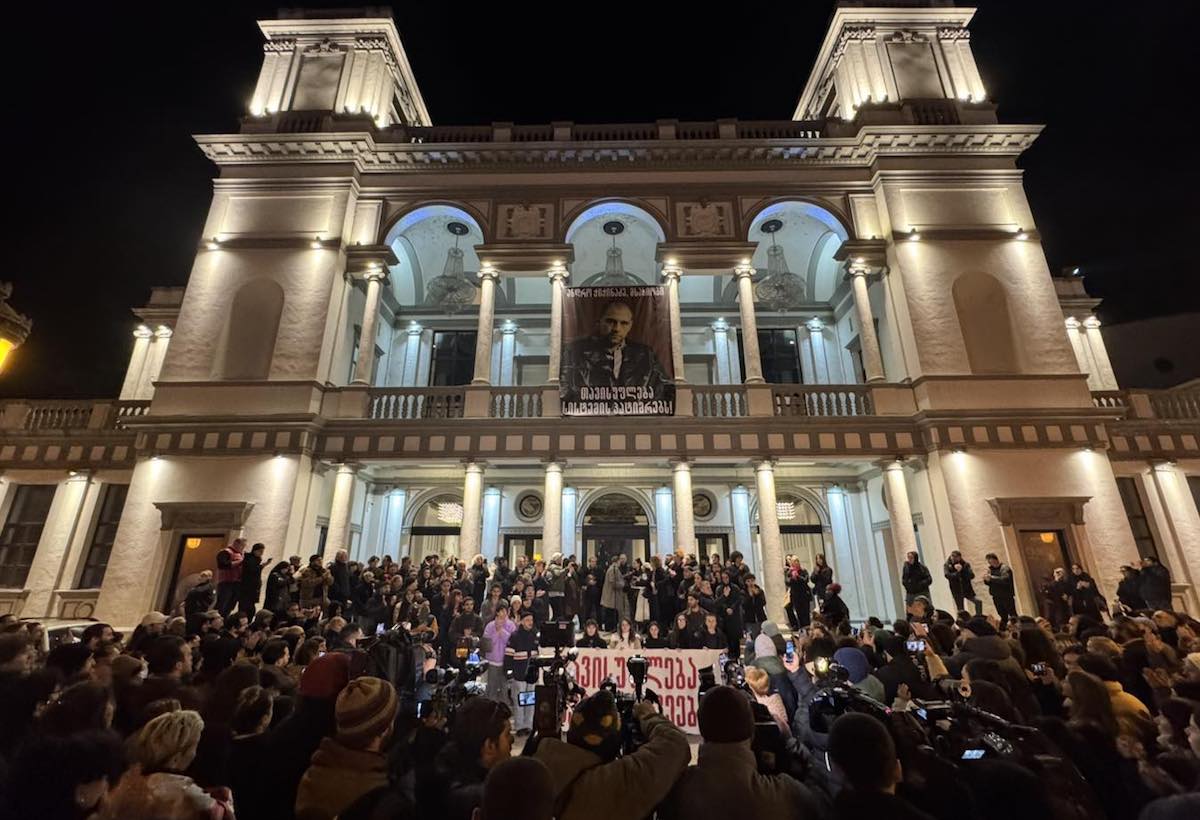 The New National Theater with the banner of the arrested director Andro Chichinadze © Data Tavadze
In a remarkable show of courage, the students of Theatre University have occupied the foyer for over 50 days, demanding new elections and the release of unjustly detained fellow fighters. Enduring days of blackmail, being locked in and out of the building, they faced deprivation of food supplies, electricity, and heating. Their actions have sparked a wave of solidarity, with students from eight other universities joining the movement by occupying the foyers of their institutions.
They transformed the facades into displays featuring banners to meet their demands. The white banners with daily changing massages on different facades became the symbol of the movement.
IN TYRANNOS!
The year was 1937, the bloodiest period of Stalin's repressions and the twentieth anniversary of the October Revolution. People stopped in shock before the Rustaveli National Theatre on Rustaveli Avenue, gazing at its facade. Beneath the portraits of Soviet leaders displayed for the special parade occasion, they noticed a banner that read, "IN TYRANNOS."
"IN TYRANNOS" was a production title by the legendary Georgian director Sandro Akhmeteli (1886-1937), based on Schiller's "Die Räuber". Akhmeteli was shot that same year. After being captured and tortured for 222 days, he was paraded in an open car before the theatre troupe.
Silence. Execution.
On January 14, 2025, Georgian Theatre Day, we marched with our audiences toward the same Rustaveli Theatre and hung a banner on its facade that read: IN TYRANNOS— Sandro Akhmeteli—AGAINST TYRANNY.
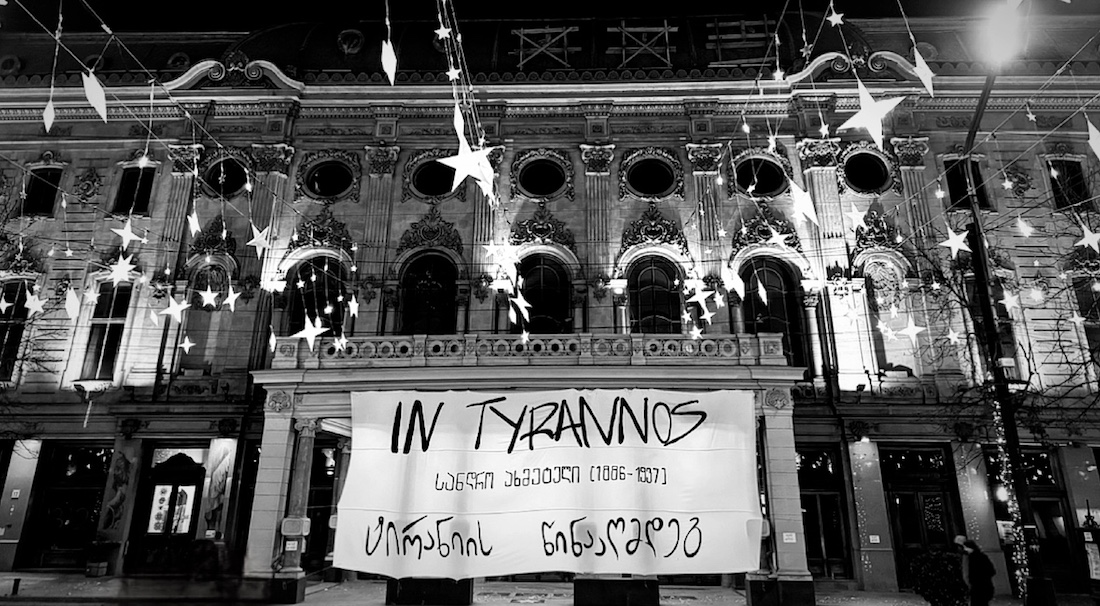 Reenactment of a protest against Stalinism on the façade of the Rustaveli National Theater in winter 2024/25 © Data Tavadze
The officials backed by the theatre management removed the banner the same day.
Georgian theatre-makers on strike now travel around Georgia with a performance manifesto supporting the protests in various cities, helping demonstrators gather and shield their fight.
We vowed that no one and nothing would ever silence us again!
JOURNALIST AGAINST TYRANNY
One of the most respected Georgian journalists, Mzia Amaghlobeli, was arrested along with her colleagues while protesting for a nationwide strike against the repressive rule of the Georgian Dream government.
Amaghlobeli was released the following day but was subsequently attacked and assaulted outside the police station by the local police chief. In a moment of self-defence, she slapped him in the face. Police officers immediately dragged her back into the station. Two days later, a court ruled to keep Amaghlobeli in pre-trial detention, pending trial on charges of assaulting a law enforcement officer. The judge deemed her a high risk of reoffending. Prosecutors are seeking a seven-year prison sentence for her.
Today, February 11, 2025, marks the 30th day of Mzia Amaghlobeli's hunger strike in prison. She cannot walk or speak any more, but no one from the state has acted on her behalf. But she sparked a wave of solidarity – the theatre actor and manager Lasha Chkhvimiani stopped his car in front of the municipality building and joined the hunger strike in her support.
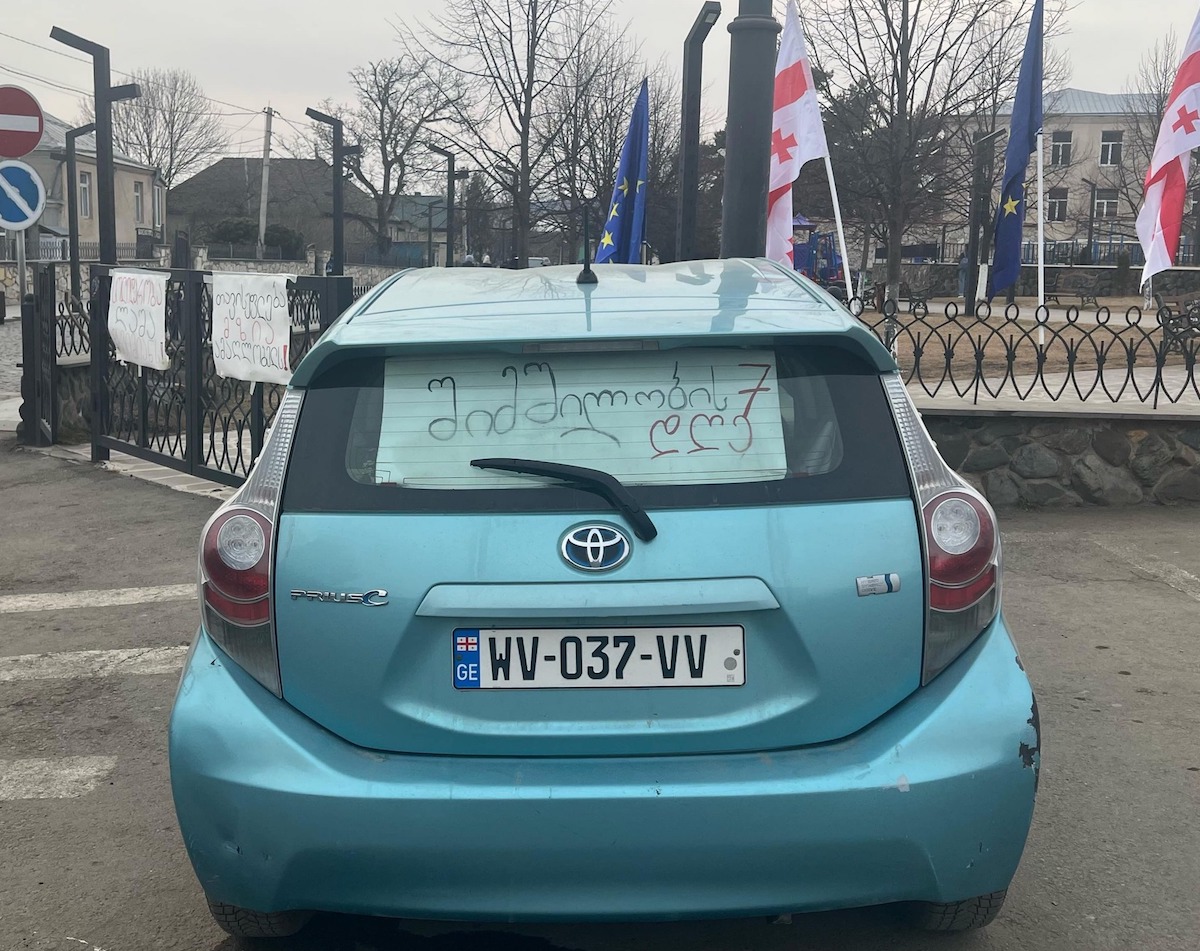 The car of theater maker Lasha Chkhvimiani on the 7th day of his hunger strike © Lasha Chkhvimiani
Here's what Mzia Amaghlobeli says in her letter from her cell:
"I do not intend to accept the regime's agenda. I am on a hunger strike. Freedom is more valuable than life. Any citizen who wishes to live in a democratic, just, European Georgia—free from Russian influence—could find themselves in my position. Fight before it's too late. Fight wherever you are—inside the country or abroad, in villages or cities, in the streets or lecture halls, in public and workspaces. Be brave, protect, and strengthen one another. Do not allow Georgia to be isolated from the civilized world."
The de facto government of a country that proclaims itself the "Georgian Dream" implies draconian laws every day. Today, it is already forbidden to block the streets or walk pavements in protest or to protest in any form in buildings without consent.
We must swiftly recognize and resist the growing authoritarian powers worldwide and stand together. Let's rise and join our voices, speak out, and take action in any way we can to fight for freedom and equality everywhere. By standing together across borders, we can amplify our struggle for justice and the freedom to create. This is not just our struggle; it is a fight for all of us to challenge power and speak the truth.
The time to act is NOW!
FIRE TO OLIGARCHY!
With stubborn Hope,
Love and Rage,
Data Tavadze
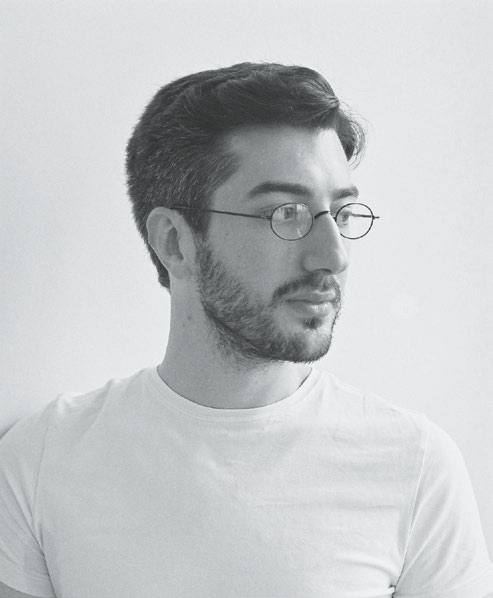 Data Tavadze (b. 1989) is a director and playwright from Tbilissi. He began his theatre career at an early age and became the leader of the Royal District Theatre in 2009. His work has gained international acclaim, with productions featured in festivals across Germany, France, Sweden, Romania, Belgium, Poland, and more. Tavadze has received multiple awards, including the Talking About Borders drama prize for "War Mother" (Kriegsmutter) and the Fast Forward Festival for Young Directors prize for "Women of Troy". He has collaborated with notable theatres, including the Deutsches Theater Berlin, Staatsschauspiel Dresden, Schauspiel Frankfurt, Badisches Staatstheater Karlsruhe, Maxim Gorki Theater Berlin, Mousonturm Frankfurt/Main, Dailes Theatre in Riga, Polish Theatre in Bydgoszcz and more.
Foto: Gregory Regini
Die deutschsprachige Version dieses Textes finden Sie hier.
meldungen >
- 17. April 2026 Kunststiftung Sachsen-Anhalt warnt vor nationalistischer Kulturpolitik
- 16. April 2026 Göttingen: Schauspielerin Thyra Uhde gestorben
- 16. April 2026 Salzburg: Ex-Festspielpräsident Heinrich Wiesmüller gestorben
- 16. April 2026 Konstanz: Intendantin Karin Becker verlängert
- 15. April 2026 Preisjurys der Mülheimer Theatertage 2026
- 13. April 2026 Chemnitz: Theater wehrt sich gegen Abschaffungspläne
theaterfestivals
 FINDE DEIN FESTIVAL!
nachtkritikregional
nachtkritikcharts
 TOP TEN DES THEATERS
dertheaterpodcast
nachtkritikvorschau
nachtkritiknewsletter
 JETZT ABONNIEREN
neueste kommentare >